

Executive Summary
RELX PLC is a global provider of information-based analytics and decision tools for professional and business customers, operating through four market-facing segments: Risk, Scientific, Technical & Medical (STM), Legal, and Exhibitions. The company has successfully completed a multi-decade transition from a traditional media publisher to a high-margin data technology enterprise, leveraging vast proprietary datasets to provide mission-critical insights. RELX earns money through a high-quality mix of recurring subscriptions and volumetric transactional contracts, characterized by superior operating margins of 34.8% and exceptional adjusted cash conversion of 99% as of the 2025 fiscal year. Its core competitive advantage stems from deeply embedded workflow tools and unique, often unreplicable data assets that create high switching costs and robust pricing power. The primary risks to the investment thesis include evolving global regulations regarding personal data privacy and the potential for generative AI to eventually commoditize specialized professional information, though current evidence suggests AI acts as a value-add accelerant for RELX. RELX functions as a defensive, high-quality compounder that dominates the professional information landscape by transforming raw data into high-value decision-making infrastructure.
1. What They Sell and Who Buys
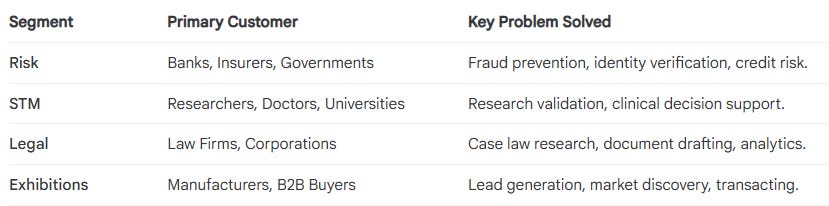
RELX operates a specialized portfolio of information-based businesses that serve four distinct professional communities. The company’s evolution has moved from providing “content” to “analytics” and is now focused on “decision tools” that drive specific customer outcomes.
Risk: LexisNexis Risk Solutions
The Risk segment is the largest contributor to group operating profit and represents the most technologically advanced portion of the RELX portfolio. It provides information-based analytics and decision tools that combine public and industry-specific content with advanced technology and algorithms to assist customers in evaluating and predicting risk.
The business is structured around market-facing verticals, including Insurance, Business Services, Healthcare, Government, and Specialized Industry Data Services (such as ICIS for commodity markets). In the Insurance vertical, LexisNexis Risk Solutions provides data and analytics services to 23 of the top 25 US insurers, facilitating 88% of new US auto insurance policies through its quoting and underwriting tools. These tools help insurers assess the risk profile of applicants, detect potential fraud, and price policies accurately in real-time.
The Business Services vertical, representing over 40% of Risk’s revenue, addresses challenges in identifying fraud, cybercrime, bribery, and corruption. Its Dynamic Decision Platform and RiskNarrative platform are used by nine of the world’s top 10 banks to comply with anti-money laundering (AML) and know-your-customer (KYC) regulations. The primary buying motivation is the reduction of financial loss from fraud and the avoidance of heavy regulatory fines.
Scientific, Technical & Medical (STM): Elsevier
Elsevier helps advance science and healthcare by combining high-quality scientific and medical information with technology. The segment maintains two primary revenue streams: Primary Research and Databases/Tools.
Elsevier is the world’s largest publisher of academic articles, maintaining over 3,000 journals including flagship titles The Lancet and Cell. In 2025, the company received approximately 4.2 million research papers, resulting in over 795,000 peer-reviewed articles published. Its ScienceDirect platform hosts over 16 million documents, serving researchers who need validated data to advance scientific knowledge.
The segment increasingly focuses on analytics and clinical tools. ClinicalKey provides clinicians with over 2,500 clinical overviews and millions of images to support bedside decision-making. ScopusAI and Reaxys AI now allow users to query massive bibliographic and chemical databases using natural language, significantly increasing the productivity of R&D teams in corporate sectors.
Legal: LexisNexis Legal & Professional
The Legal segment provides tools that combine legal, regulatory, and business information with powerful analytics to help lawyers achieve better outcomes for their clients. LexisNexis holds the #2 market position in the US and either #1 or #2 positions in major markets outside the US.
Core products include the Lexis+ platform, which integrates traditional legal research with AI-enabled analytics. The recent acquisition of Henchman enabled the launch of Protégé, a personalized legal assistant that allows law firms to combine their internal proprietary data with LexisNexis’s external legal database for faster, more accurate document drafting. The primary customer profile includes law firms, corporate legal departments, and government judicial bodies, all driven by the need to increase billable efficiency and reduce the risk of missed precedents.
Exhibitions: RX
RX (formerly Reed Exhibitions) is the world’s largest exhibitions company, organizing approximately 350 events annually across 41 industry sectors. Its portfolio includes industry-defining events like New York Comic Con and JCK (jewelry).
Post-pandemic, the segment has transitioned toward a “digitally enhanced face-to-face” model. The RX NOW platform provides AI-powered recommendations to attendees, matching them with exhibitors based on their specific business needs. This data-driven approach allows exhibitors to demonstrate a clearer ROI, making event participation a structural part of their sales and marketing expenditure rather than a discretionary expense.
2. Revenue Model
RELX utilizes a highly resilient revenue model that has shifted from legacy print cycles to a predictable, technology-driven structure. As of 2025, group revenue reached £9,590 million, reflecting an underlying growth rate of 7%.
Pricing and Value Capture
The company prices its services based on the perceived value to the user’s workflow rather than a simple data-access fee. In the Risk segment, pricing is often transaction-based or volumetric, tied to the number of insurance quotes or credit checks processed. In STM and Legal, the model is predominantly subscription-based, where institutions pay for enterprise-wide access to platforms like ScienceDirect or Lexis+.
In the academic publishing arm, Elsevier employs a hybrid model:
Subscription (Traditional): Institutions pay for access to read content.
Open Access (Transactional): Authors or their funding bodies pay Article Publishing Charges (APCs) to make their research freely available.
Revenue Structure by Format and Type
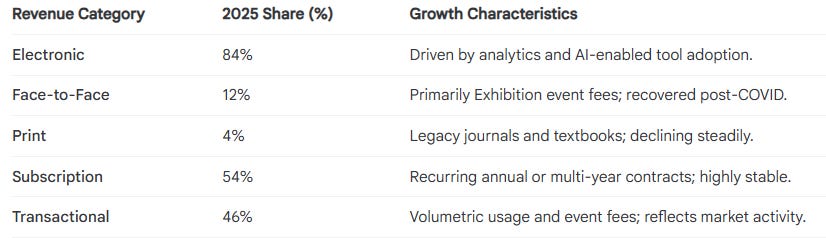
The transition to digital format is effectively complete, with electronic revenue now accounting for 84% of the group total.
Segment Revenue Contribution
In 2025, the revenue mix showed the continued dominance of the Risk and STM segments in terms of scale:
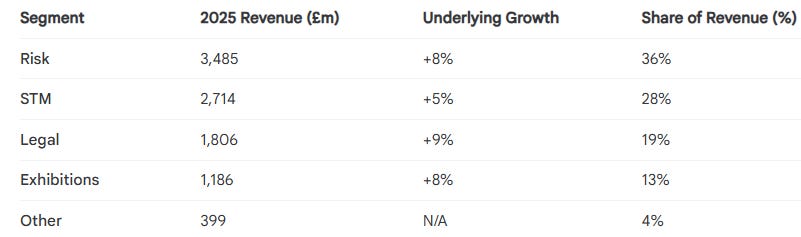
The “Other” category primarily includes inter-segment eliminations and print-related activities not assigned to specific segments.
3. Revenue Quality
RELX’s revenue quality is distinguished by high predictability, low customer concentration, and geographic diversification. The 54% subscription base acts as a robust floor for revenue, while the 46% transactional portion is often governed by long-term contracts with volumetric elements, making it more stable than traditional “one-off” sales.
Predictability and Stability
The subscription model is most prominent in STM (Elsevier), where 80% of revenue is subscription-based. These contracts are typically negotiated with large university consortia or corporate R&D departments, often on multi-year terms. The Legal segment also shows high stability, with subscription revenue accounting for approximately 75% of segment revenue.
In the Risk segment, while 61% of revenue is classified as “transactional,” this is driven by recurring needs such as insurance quoting and policy switching. When a consumer searches for a better auto insurance rate, an insurer must ping LexisNexis to pull the applicant’s risk profile. This activity is a structural necessity of the insurance market, providing a high degree of “programmatic” stability regardless of the broader macro environment.
Geographic and Segment Concentration
RELX has a broad geographic footprint, reducing sensitivity to any single economy, although the US remains its most important market.

In the Risk segment, the US concentration is significantly higher at 79%, reflecting the mature nature of the US insurance and credit markets.
Macro-Sensitivity and Cyclicality
The business is largely counter-cyclical or non-cyclical. Scientific research, legal compliance, and fraud detection are non-discretionary expenses for professional customers. The Exhibitions segment is the only business area with significant macro-sensitivity, as event spend is often a variable component of corporate marketing budgets. However, Exhibitions now represents only 13% of group revenue, down from higher historical levels, limiting the group’s overall exposure to economic cycles.
4. Cost Structure
RELX maintains a highly efficient cost structure characterized by significant operating leverage. The company’s stated objective is to manage cost growth below revenue growth through “continuous process innovation”.
Key Cost Drivers
Labor: RELX employs over 37,000 people. Employee costs are the largest component of the expense base, particularly as the company competes for high-level technical talent in AI and data science.
Technology and R&D: The company spends over £2 billion annually on technology. Total capital expenditure in 2025 was £525 million, of which £504 million was dedicated to capitalized development costs for new digital tools.
Content Acquisition: While Elsevier relies on the academic community for peer review and article submissions, there are significant editorial and technical costs associated with managing the “record of science” and maintaining journal quality.
Margin Profile
The transition from print to digital has removed the variable costs associated with physical manufacturing and distribution, shifting the business to a high-fixed-cost, high-margin software-like profile.
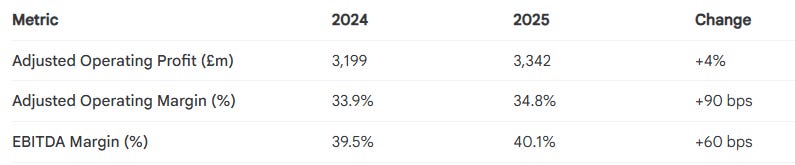
Note: Adjusted figures exclude the amortization of acquired intangible assets and other acquisition-related items.
Operating Leverage and Scaling
As revenue scales, the incremental cost of serving an additional digital user is negligible. This is evident in the Legal segment, where underlying revenue growth of 9% translated into underlying adjusted operating profit growth of 12% in 2025.
5. Capital Intensity
RELX is a capital-light business. Its primary assets are intangible—proprietary datasets, software code, and brand reputation—rather than physical property or equipment.
CapEx has remained remarkably consistent at approximately 5% of revenue over the last decade, indicating that growth does not require increasing levels of capital intensity.
Working Capital and Cash Conversion
The business benefits from favorable working capital dynamics, particularly in its subscription-based segments where revenue is often collected in advance of service delivery.
Adjusted Cash Flow Conversion: 99% in 2025, up from 97% in 2024.
Free Cash Flow: Increased to £2,313 million in 2025 from £2,126 million in 2024.
This high cash conversion allows RELX to fund its dividend, M&A, and buyback programs entirely through internally generated funds while maintaining a stable leverage profile.
6. Growth Drivers
RELX’s growth trajectory has accelerated as it has moved deeper into analytics and decision tools. The company’s long-term growth is driven by structural shifts in the professional information economy.
Primary Levers
AI-Enabled Product Innovation: The integration of Generative AI (e.g., Lexis+ AI, ScopusAI) allows RELX to deliver significantly more value, supporting higher pricing and driving new sales.
Increased Volumetric Usage in Risk: As digital transactions increase globally, the demand for fraud prevention and identity verification scales naturally.
Mix Shift to Higher-Value Tools: RELX is successfully transitioning customers from basic data access (low growth) to sophisticated analytics platforms (high growth).
Open Access Volume: In STM, Elsevier is capturing growth from the rising global output of scientific research, particularly from emerging economies like China and India.
Structural vs. Cyclical Tailwinds
Structural (Durable): The “explosion” of data and the increasing regulatory burden on financial institutions are durable, multi-year trends that favor RELX’s Risk and Legal segments.
Cyclical (Short-term): The post-pandemic rebound in Exhibitions provided a temporary boost in 2023–2024, but this is now normalizing to a steady-state growth profile.
Growth Constraints and Execution Risks
The single biggest constraint is regulatory risk regarding personal data. Any significant legislative change that restricts the collection or use of personal data could impact the Risk segment’s ability to score credit or detect fraud. Additionally, cybersecurity is a critical execution risk; because RELX’s value is based on the integrity and exclusivity of its databases, a major breach could cause irreparable reputational damage and legal liability.
7. Competitive Moat
RELX possesses a formidable “wide” moat based on proprietary data, high switching costs, and the “tollbooth” nature of its services.
Sources of Economic Protection
Proprietary and Unreplicable Data: RELX owns 119 billion documents in its legal and news databases and tracks 2 billion automated bot attacks for fraud prevention. This data is often historical and proprietary, making it impossible for a new entrant to replicate.
Embedded Workflow and Switching Costs: LexisNexis and Elsevier tools are integrated into the daily workflows of lawyers and scientists. Switching to a competitor requires not just a new software purchase, but the retraining of staff and the potential loss of integrated internal research data.
Network Effects in STM: The most prestigious researchers want to publish in the highest-impact journals (Elsevier), which in turn ensures those journals maintain the highest impact, creating a self-reinforcing loop that sustains subscription demand.
Regulation as a Barrier: In the Risk segment, providing FCRA-compliant data in the US requires significant legal and technical infrastructure that acts as a natural barrier to new competitors.
Evidence of Moat Durability
The durability of the moat is reflected in the company’s superior Return on Invested Capital (ROIC) and consistent margin expansion.

ROIC has consistently stayed well above the company’s cost of capital, a classic indicator of a durable competitive advantage.
Assessment: Widening
The moat is widening due to the adoption of AI. While GenAI has lowered the cost of generating text, it has increased the value of verified, authoritative data. RELX is one of the few entities that can ground AI outputs in trusted legal and scientific “truth” sets, making its platforms even more essential in a world of AI-generated misinformation.
8. M&A and Capital Allocation Track Record
RELX follows a highly disciplined, “programmatic” M&A strategy. Rather than large, transformational deals that carry high integration risk, the company focuses on small, strategic “tuck-ins”.
Strategic Intent and History
The primary goal of M&A is to acquire specific technology, such as an AI algorithm or a unique dataset, that can be rolled out across RELX’s existing global customer base.
Henchman (2024): Acquired for approximately $160 million, this Belgian start-up provided the core document drafting technology for the Lexis+ AI assistant.
IDVerse (2025): Acquired to enhance the Risk segment’s ability to detect fake identity documents using cutting-edge computer vision.
3D4Medical (2019): Acquired to accelerate the transition of Elsevier’s medical textbooks into interactive digital anatomy tools.
Financial Performance and Integration
The financial success of this strategy is evident in the lack of significant goodwill impairments and the steady rise in ROIC.
Valuation Multiples: RELX typically pays fair market prices for high-growth tech assets but avoids “bidding wars”.
Talent Retention: The company prides itself on a “gradual and involved” integration process that preserves the creative talent of the acquired firms. For example, the founders of 3D4Medical and Henchman remained with the company to lead product evolution.
Capital Allocation Summary
RELX’s cash-generative nature allows for a “multi-pronged” capital allocation strategy that consistently returns value to shareholders.
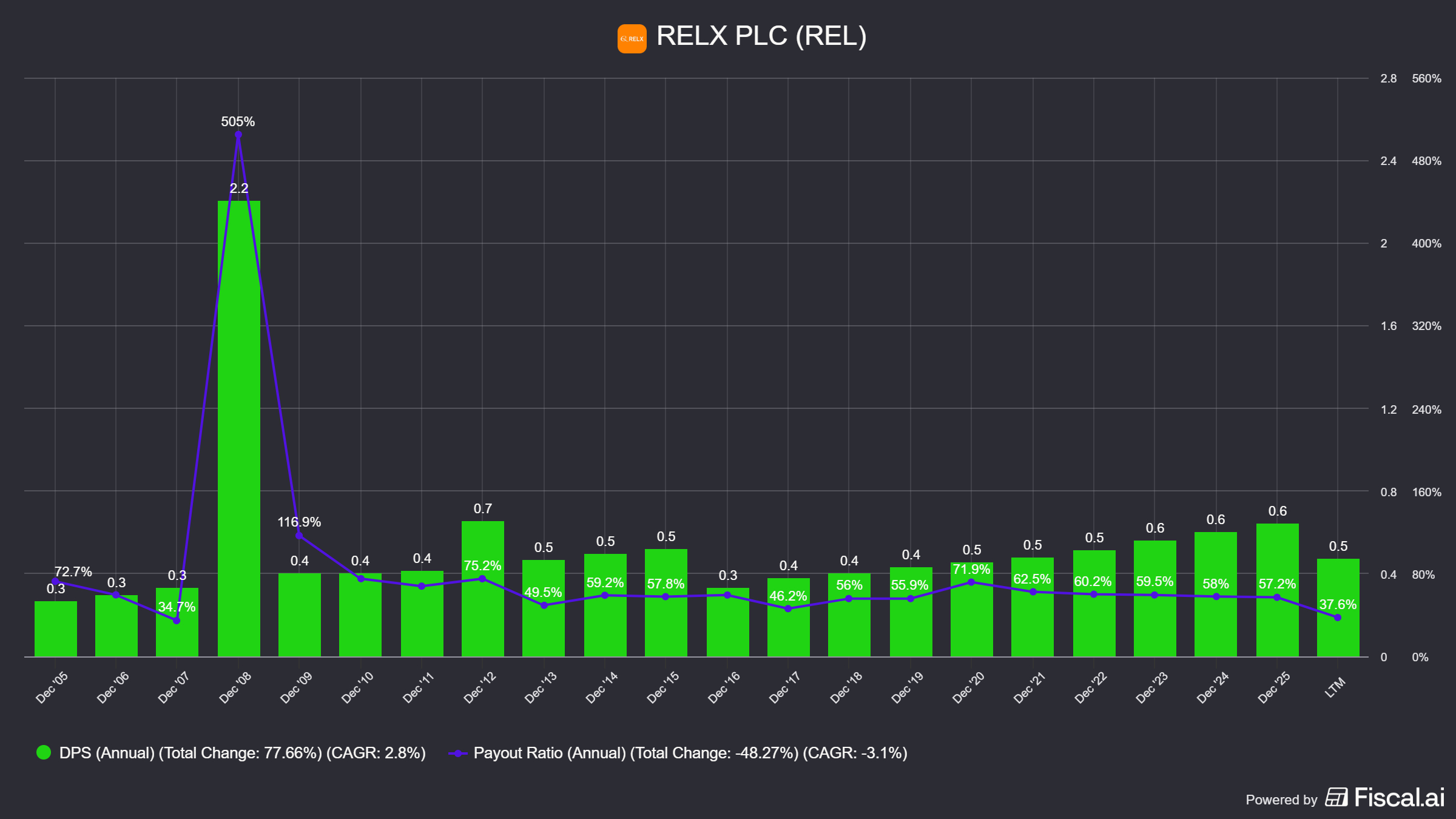
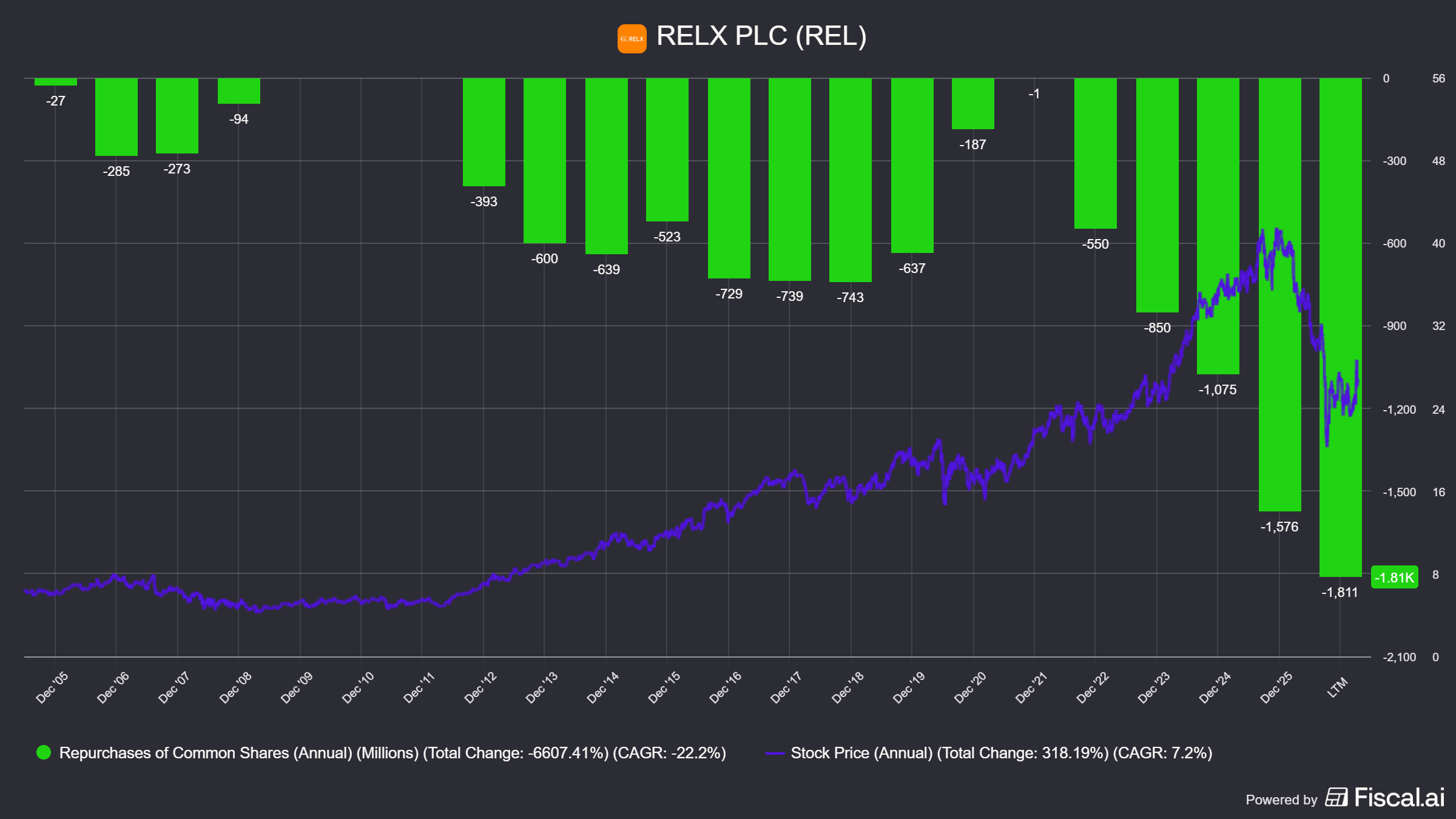
The company maintains a strong balance sheet with a Net Debt/EBITDA ratio of 2.0x, providing flexibility for continued investment and shareholder returns.
Conclusion
RELX PLC stands as a premier example of a successful digital transformation. By moving away from the cyclicality and margin pressures of print media into the “tollbooth” economics of data analytics, the company has created a high-barrier, non-cyclical business model. For long-term investors, the combination of mid-single-digit underlying revenue growth, double-digit EPS growth (driven by margin expansion and buybacks), and a 15%+ ROIC makes RELX a high-conviction “quality” compounder in the professional services sector.
Thanks for reading!
Stiliyan Loukanov, Feather Fund
Open an account with Interactive Brokers:
https://ibkr.com/referral/stiliyan756
Sign up to Revolut with the link below to support the blog:
ttps://revolut.com/referral/?referral-code=stiliyujwu!MAY1-24-AR
Open an account with eToro to support the blog:
Disclaimer: The information presented here, including ideas, opinions, views, predictions, forecasts, commentaries, or suggestions, whether explicitly stated or implied, is intended purely for informational, entertainment, or educational purposes. None of the content should be interpreted as personalized investment or financial advice. Although every effort has been made to ensure the accuracy of the information provided, errors or inaccuracies may be present. Always exercise caution and seek professional financial advice before making any investment decisions.